Oxidative stability: why your cooking oil matters more than you think
When polyunsaturated seed oils are heated, they break down into harmful compounds. Here's what the research says about oxidation, aldehydes, and why stable fats are safer fats.
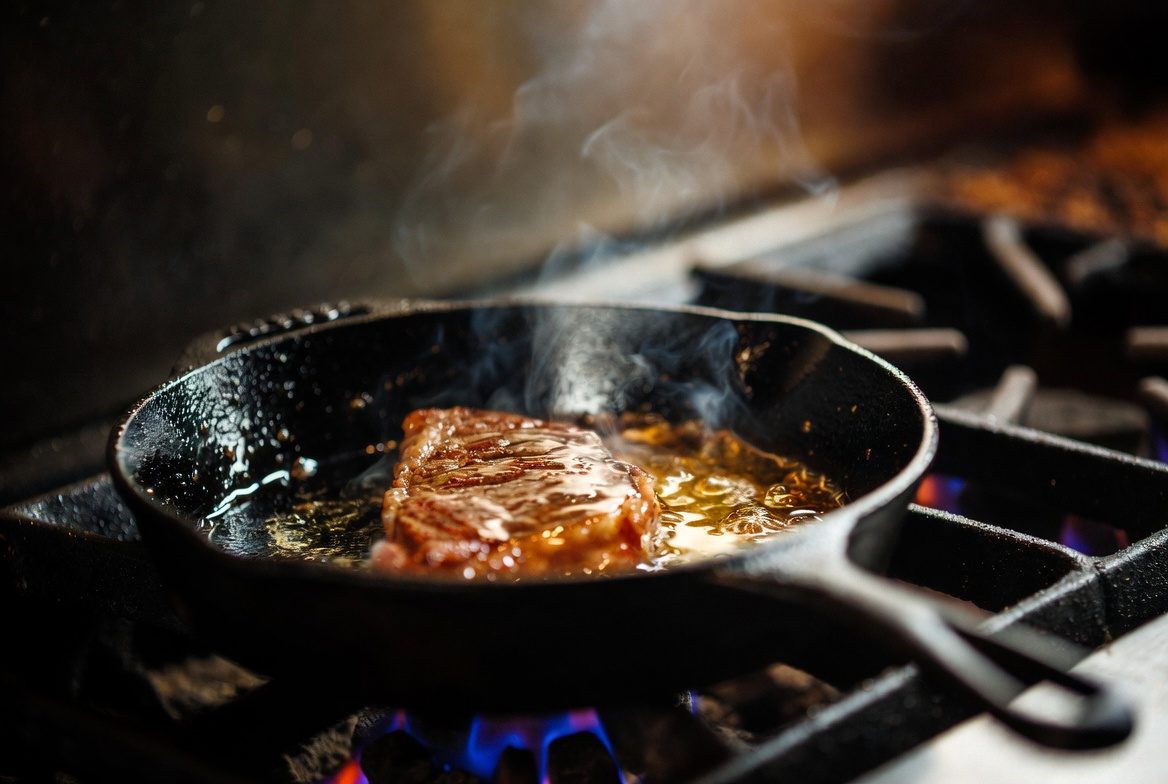
Smoke point gets all the attention, but it's not the most important number. What matters more is what happens to a fat below its smoke point — specifically, how quickly it oxidises and what it breaks down into.
What is oxidation?
When a fat is exposed to heat, light, or oxygen, its molecular bonds can break. This process — oxidation — produces a range of breakdown products including aldehydes, peroxides, and other reactive compounds. The more chemically unstable a fat is, the more readily it oxidises.
Polyunsaturated fats (PUFAs) are the least stable. Their multiple double bonds are vulnerable to attack by heat and oxygen. This is basic chemistry, not opinion.
Saturated and monounsaturated fats are far more stable. Fewer double bonds means fewer points of vulnerability.
What forms when seed oils are heated
A landmark 2012 study by Grootveld et al. (Food Chemistry) analysed the volatile compounds produced when common cooking oils were heated to frying temperatures. The results were striking:
- Sunflower oil and corn oil produced 20–30 times more aldehydes than butter or coconut oil at the same temperature.
- The aldehydes produced included 4-hydroxynonenal (4-HNE) and malondialdehyde (MDA), both of which are classified as cytotoxic and genotoxic — they damage cells and DNA.
A 2015 follow-up by the same group, presented at a meeting of the American Chemical Society, confirmed that even brief frying with polyunsaturated oils generated aldehyde levels well above World Health Organisation safety limits.
Tallow's advantage
Beef tallow is approximately:
- 50% saturated fat
- 42% monounsaturated fat
- 4% polyunsaturated fat
With only 4% PUFAs, tallow produces dramatically fewer oxidation products when heated. Its high proportion of stable saturated and monounsaturated fats means it can withstand prolonged high heat with minimal breakdown.
This is why tallow was the default frying fat for centuries — and why McDonald's chips tasted better before they switched to vegetable oil in 1990.
Repeated heating makes it worse
In commercial kitchens and home cooking alike, oils are often reused. A 2010 study by Srivastava and Singh (Journal of Food Lipids) found that repeatedly heated seed oils showed:
- Progressive increases in free radical content
- Accumulation of polar compounds (markers of degradation)
- Increasing concentrations of trans fatty acids
Tallow, by contrast, maintained its structural integrity through multiple heating cycles far better than any of the polyunsaturated oils tested.
Smoke point is misleading
Refined seed oils often have smoke points of 220–240°C, which sounds impressive. But a high smoke point only means the oil doesn't visibly smoke — it says nothing about the chemical reactions happening inside the oil.
A study by De Alzaa et al. (2018, Acta Scientific Nutritional Health) found that extra virgin olive oil — with a lower smoke point than many seed oils — produced fewer harmful polar compounds at high heat because of its low PUFA content and high antioxidant levels. The same principle applies to tallow.
Stability, not smoke point, is the relevant measure.
The bottom line
Every time you heat a polyunsaturated seed oil, it produces aldehydes and other compounds that are associated with inflammation, cellular damage, and oxidative stress. The more double bonds in the fat, the more breakdown products.
Tallow, with its 96% saturated and monounsaturated content, is one of the most oxidatively stable cooking fats available. It does what a cooking fat should do: stay intact under heat, add flavour, and not generate harmful byproducts.
References: Grootveld M et al. (2012) Food Chemistry; De Alzaa F et al. (2018) Acta Scientific Nutritional Health; Srivastava S & Singh M (2010) J Food Lipids.